The Democrats’ midterm win is real, but it is not instant power. This post, plainly and without exaggeration, explains what is possible in the next 60 days, what becomes possible after January 3, and what remains impossible even after the win.
One rule runs through all of it: judge actions, not words. In Iran policy, statements, threats, and interviews carry the least value. What matters is troop movement, money, and law.
1. Why a win is not power yet
The newly elected Democrats do not take their seats until January 3. Until then, the current Congress, with a Republican majority, makes the decisions. This gap is called the lame duck period: the outgoing Congress still legislates, while the incoming Congress has no votes yet.
So for the next 60 days, the winning Democrats can announce positions, negotiate, and apply public pressure. They cannot pass a bill, run a committee, or block a bill with their own votes. Current Democrats, in the minority, have tools, but they do not control the House floor.
2. The danger is in these 60 days
The main danger is in this transition period. The old Congress can do two things that are hard to reverse later.
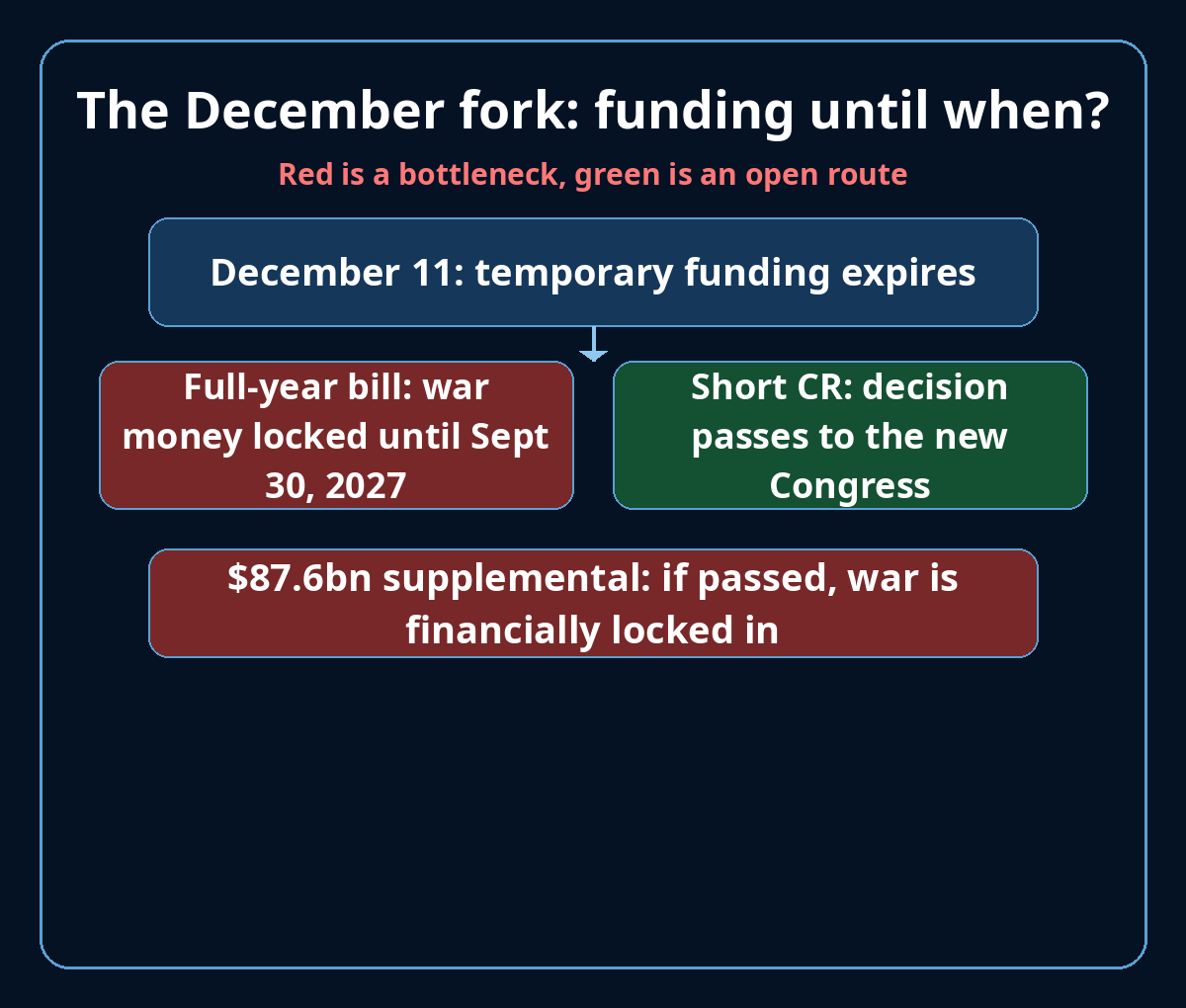
First, Iran war funding. The administration has asked for about $87.6 billion in supplemental funding, meaning extra money beyond the regular budget, with about $67 billion of it for the Pentagon, including about $21 billion for munitions. If that money is approved in this Congress, the war is financially locked in for a while, even if the new Congress opposes it. Taking back approved money requires a new law, with Trump’s signature or 67 Senate votes to override his veto.
Second, the defense authorization bill, the NDAA. This annual bill sets defense policy, but it does not itself spend money; appropriations bills spend. Inside the NDAA is the United States-Israel defense technology cooperation plan: Section 219 in the House version, Section 1217 in the Senate version. It would expand cooperation in research, testing, and integration of defense technology, including AI, autonomous systems, electronic warfare, and advanced sensing, and it allows “network integration” and “data fusion” between the two militaries.
Critics, including Reps. Rashida Tlaib and Ro Khanna, call this merging the US and Israeli militaries. Supporters, including the think tank JINSA, say it is not a merger of command: no American soldier would serve under Israeli command or vice versa, but Israeli-origin technology would enter US systems. Hear both framings separately; neither should be taken as settled fact on its own. What is legally clear is this: if this provision is passed and signed in this Congress, the next Congress would need a new law and Trump’s signature to repeal it. If it is not passed, the new Congress can strip it, narrow it, or attach conditions such as annual reporting and a security review.
One more December point: the government is currently operating under a continuing resolution, a CR, through December 11. The main December fight is over duration. If the old Congress passes a full-year bill, war funding is locked in through September 30, 2027. If it passes only a short CR expiring after January 3, the main decision passes to the new Congress. In the Senate, a funding bill usually needs 60 votes to end debate, and Republicans do not have 60 on their own. So current Senate Democrats can refuse the 60th vote for a full-year lock-in without conditions, and insist on a short CR. But they cannot pass their own version alone.
3. Why Trump and Hegseth cannot simply be removed
This is the hardest part to say plainly, and it must be said plainly.
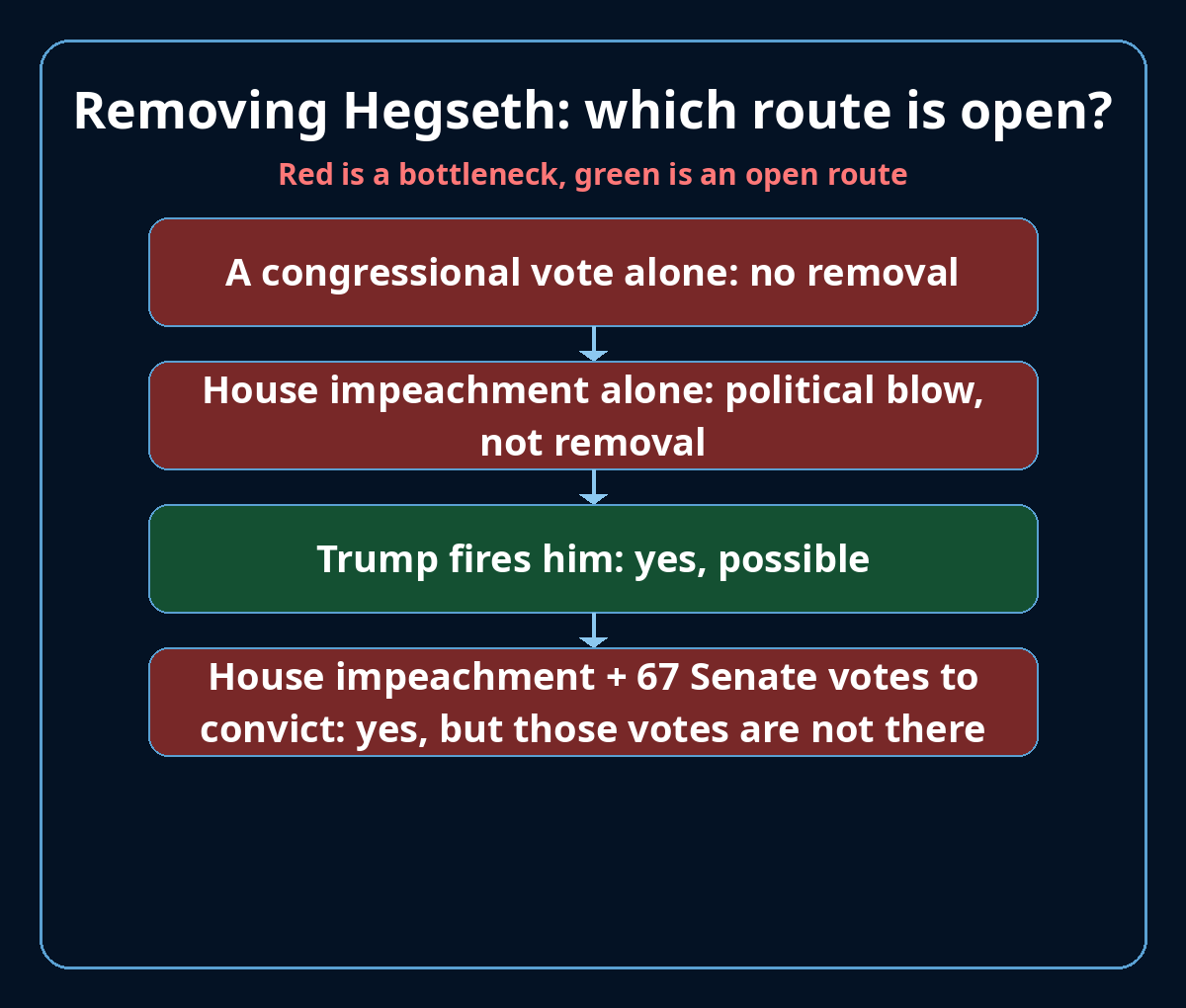
Removing a president has two steps: impeachment in the House by a simple majority, and conviction in the Senate by 67 votes. Democrats, even after winning Congress, do not have those 67 votes. So impeachment by the House alone is a political blow, not a removal.
A defense secretary cannot be removed by a congressional vote at all. Congress has no power to fire a secretary. There are only three routes: Trump fires him, he resigns, or after House impeachment, the Senate convicts him by 67 votes. There is no fourth route in law. So any promise to “remove Hegseth by a vote of Congress” is false.
But Congress is not powerless against a secretary. It can pressure him with subpoenas, public hearings, blocked appointments, and denied funding priorities.
4. Real power, exactly
Ranked from most extreme to most likely, the Democrats’ options are:
- Impeach and remove Trump: legally possible, blocked in practice by the 67-vote wall.
- Shutdown or debt-limit leverage: powerful, but double-edged, and it does not instantly stop a war funded by the base budget.
- A War Powers termination resolution: it has a special, time-limited procedure in the Senate, but it ends up against a presidential veto, and overriding that veto takes 67 votes.
- Repeal the 2001 and 2002 AUMFs, the war authorizations: same veto problem, and the administration could claim inherent commander-in-chief authority, a contested legal claim, not a settled one.
- Conditions in appropriations: writing that money may not be used for a ground invasion, for expanding the war to a new target, or for the Israel cooperation plan without reporting and review. Such a condition either needs Trump’s signature, or 67 votes to override his veto.
- Kill future money by refusing the supplemental: the simplest and most concrete power. A bill that never passes needs no override. That alone blocks escalation and weapons replenishment, even if it does not stop today’s operations, which are already funded.
- Block nominations and promotions: a simple Senate majority, with no veto involved. Hegseth’s deputies, ambassadors, and generals’ promotions cannot take office without Senate approval.
- Oversight: subpoenas, hearings, GAO investigations, and demands for legal memos, real cost figures, casualty numbers, and interceptor stock levels. This does not stop a war, but it makes secrecy harder and raises its political cost.
- Messaging bills and forced recorded votes: bills that are expected to be vetoed, but that force every member to record a public position.
5. What the 60-vote hurdle means
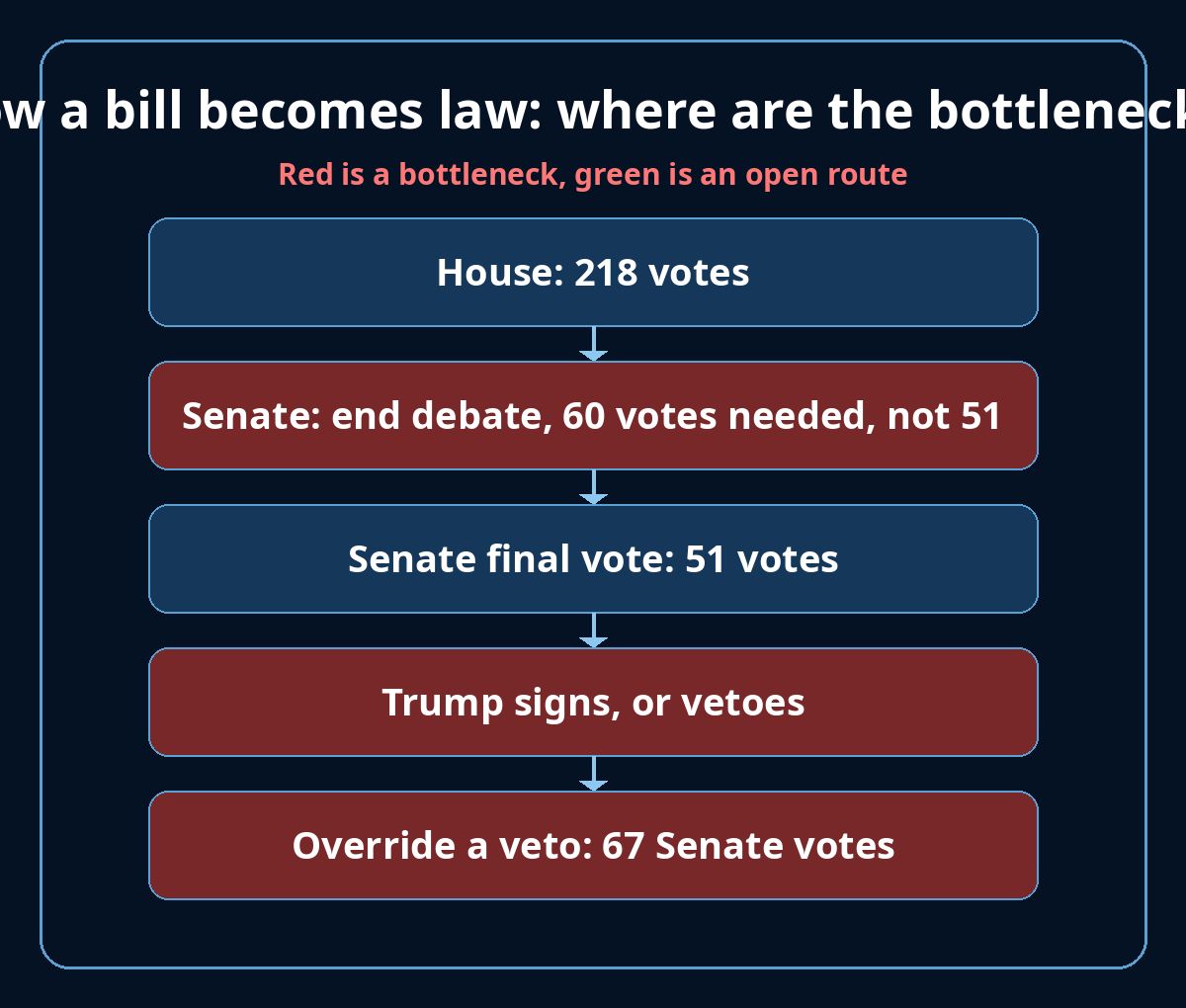
This is needed to understand everything above. Sixty votes is not the vote to pass a bill; it is the vote to reach a vote. The Senate has 100 senators, and ordinary passage takes 51 votes, but before a final vote, debate must end, and Senate debate has no time limit. A minority can filibuster, meaning block a bill by refusing to end debate. Breaking that block requires a cloture vote, a vote to end debate, which takes 60 votes, not 51.
A simple example: a bill with 52 supporters and 48 opponents passes the House, but in the Senate the cloture vote is 52 to 48, below 60, so debate never closes, the bill never reaches a final vote, and it effectively dies.
So Democrats, even with 51 or 53 seats, need several Republican votes for most ordinary bills. In a previous war powers vote, Collins, Murkowski, Paul, and Tillis voted with Democrats, so that coalition is possible, but not guaranteed.
There are exceptions: confirmations take 51 votes; budget reconciliation takes 51 votes but only for fiscal matters, not any foreign policy; and a War Powers resolution has a special procedure, but still ends up against a veto. Sixty votes is not in the Constitution; it is the Senate’s own rule, and the Senate can change it by 51 votes, the so-called nuclear option, but that carries a heavy political cost, because the party that removes the barrier today will be defenseless in the minority tomorrow.
6. Three things that cannot be done
With all the tools above, three things cannot be done: first, bring troops home with a non-binding resolution alone, meaning a resolution that only states Congress’s opinion and has no force of law, which the president can ignore. Second, take back money already approved without a new law. Third, fire the defense secretary by a congressional vote.
7. A realistic forecast
The most realistic scenario is this: in the next 60 days, the main battle is over funding, not removal. If the old Congress passes a full-year budget and the Israel cooperation provision, the new Congress will be more constrained. If a short CR passes instead, the new Congress can block new war money, freeze appointments, and raise the political cost of the war through oversight, but it cannot switch off a war that is already funded and ordered by the president with a single signature.
That is neither a complete victory nor a complete defeat. It is a limit, but not an ineffective one. The difference between a war with new money and full stockpiles, and a war without them, is the difference between escalation and attrition.
Short glossary
- Lame duck: the period between an election and the seating of the new Congress.
- Supplemental: extra money beyond the regular budget, requested for a new need.
- NDAA: the annual defense authorization bill; it sets policy but does not itself spend money.
- CR: a continuing resolution, a temporary budget that keeps the government running at prior levels until a set date.
- Filibuster: a minority blocking a bill in the Senate by refusing to end debate.
- Cloture: the vote to end debate, which takes 60 votes.
- Veto: the president’s rejection of a bill; overriding it in the Senate takes 67 votes.
- AUMF: the 2001 and 2002 war authorizations that administrations have cited for military operations.
- GAO: the Government Accountability Office, Congress’s own research and audit arm.
- Non-binding resolution: a statement of Congress’s opinion, with no force of law.